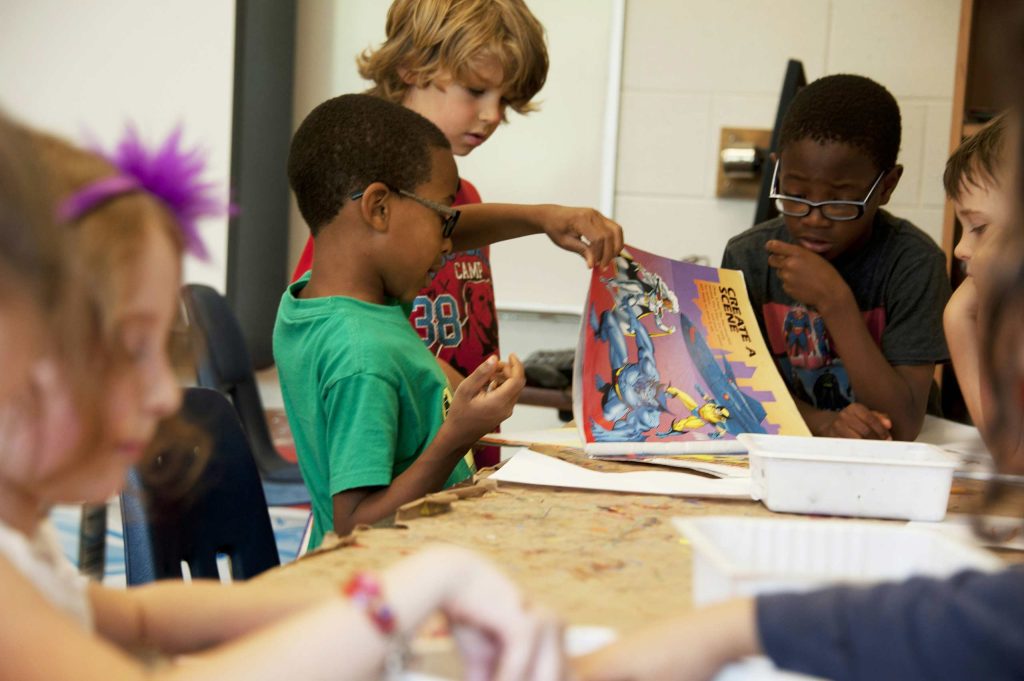
The foundation years
The Lower School curriculum is designed to build the intellectual foundations that make genuine academic rigor possible later.
In Grades K–2, the central work is foundational literacy and numeracy. Reading is taught systematically, with daily instruction in phonics, phonemic awareness, and fluency. We assess frequently — not to rank students, but to catch difficulty early and respond to it before it compounds. Mathematical reasoning is introduced alongside arithmetic from the beginning.
In Grades 3–4, the work becomes more complex and more demanding. Students begin writing in multiple genres, encountering primary source documents in history, conducting structured scientific inquiry, and engaging with literature as a subject of analysis rather than simply a source of story. The transition from learning to read to reading to learn happens here.
Throughout the Lower School, specialist teachers in visual art, music, physical education, and library science work alongside homeroom teachers as an integral part of the Lower School program.
Curriculum highlights
- Explicit phonics and literacy instruction through Grade 2, with structured, individualized support
- Mathematical reasoning integrated with arithmetic from Kindergarten
- Writing in personal narrative, informational, and persuasive genres by Grade 4
- Introduction to primary source documents in Grade 3 history
- Structured scientific inquiry beginning in Grade 2
- Spanish language instruction beginning in Grade 3
A morning in Grade 3
What a parent watching this day would notice most is not the content. It is the quality of attention. Students are active participants in something they have been invited to take seriously.
8:15
Three students are reading independently at their desks. Two are at the back table finishing a map they started yesterday in history. One is at the whiteboard working through a multiplication problem she got wrong on Tuesday, because she knew she was close and wants to find where she went wrong.
8:30
Morning meeting begins. It lasts twenty minutes. Today a student shares a non-fiction book she found about migratory birds. Another student asks whether birds navigate by stars or by magnetic fields. Ms. Ferreira says she isn’t sure — does anyone want to find out? Two hands go up.
Literacy block: 8:50 – 10:15
The class is working on informational writing. Students have chosen their own topics — one is writing about the history of chess, one about how hurricanes form, one about her grandmother’s immigration from the Dominican Republic. The writing will be presented at the Author’s Chair event in October, before an audience of families and peers.
10:15 – 12:30
Mathematics, Spanish, and lunch.
1:00 – 3:30
In the afternoon there is science — a structured, three-week inquiry unit on plant growth — then independent reading.